


About the Artist
Born in Farnham, Surrey in 1970, Phil Ashcroft is a painter and graphic artist based in south-east London. After completing a BA in Illustration at Harrow College of Art and Design, and a post-graduate diploma in Illustration at Saint Martins, Ashcroft went on to become a finalist in the John Moores Painting Prize 2014, the Celeste Art Prize 2007 and was selected for the Contemporary Art Society’s ARTfutures two years running.
While some of Ashcroft’s work consists of dystopian canvases, quasi-surreal settings, and stark landscapes, others contrast, featuring cartoonish motifs like the abominable snowman in Yeti Over Mount Fuji. Ashcroft’s canvases often feature overwhelming, stark, flat planes resembling vector images of stalactites and cliffs of the British coastal landscape, and reminiscent of Franz Kline’s .
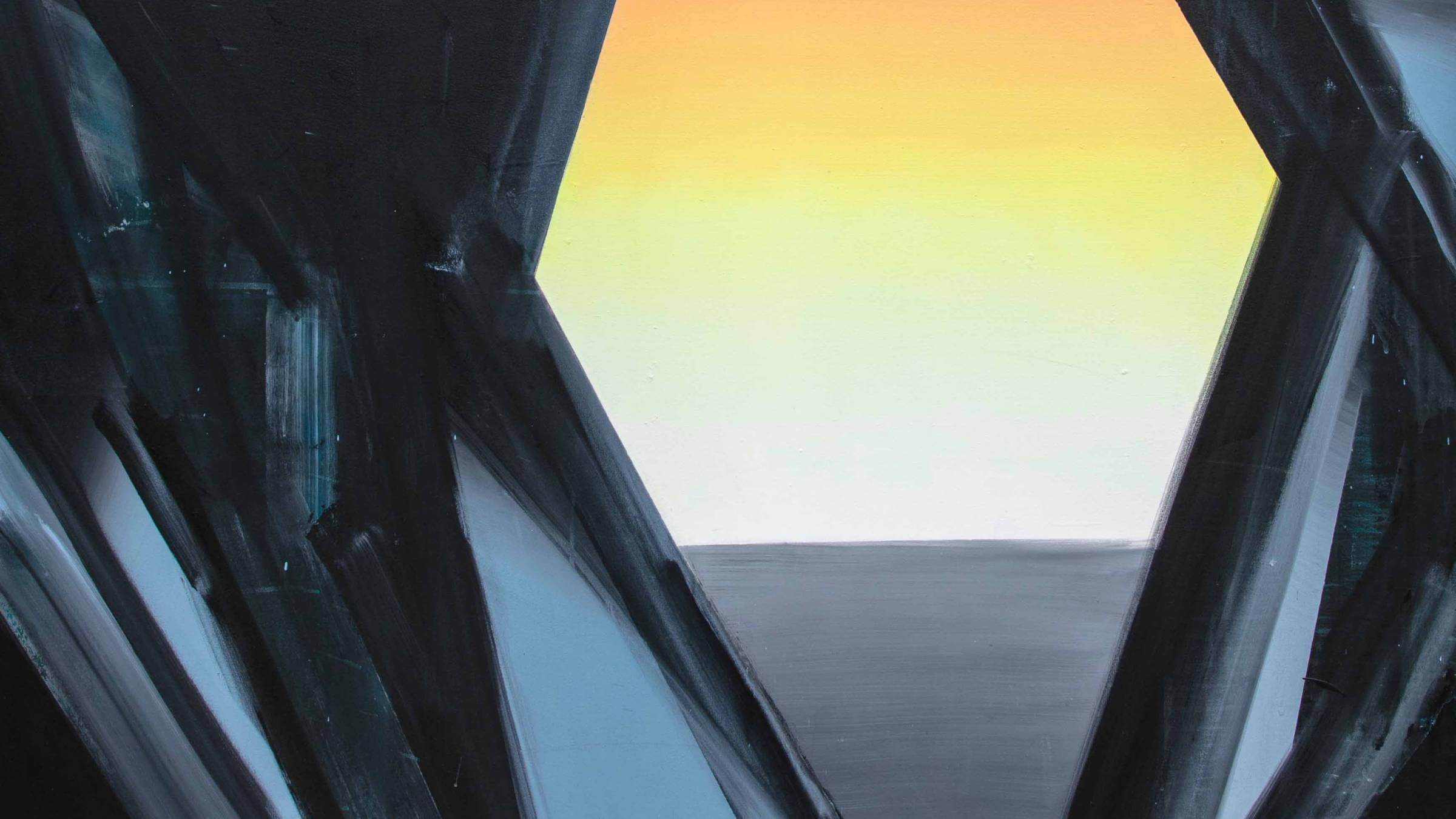
Idiosyncratically, Ashcroft applies paint gesturally and emotively to angular, flat planes of colour, creating an effect in opposition to what the viewer might expect from a self-described “postapocalyptic landscape painter”. This results in repressive forms that retain an organic and inherently emotive nature. By refusing to depict the oppressive forms clinically and robotically, Ashcroft’s canvases lay bare the human origin of dystopias themselves. Failed modernist ideals of nuclear power plants are dwarfed by megacities, dwarfed by huge factories and dwarfed again by oppressive black masses that occupy the upper halves of his canvases.
Ashcroft further emphasises the scale of the environmental and social problems humans have created by physically scaling down the human element to the level of debris. Human structures are diminutive, daubed in one or two shades with minimal detail. These destitute human outposts are confined to the bottom halves of Ashcroft’s canvases, awaiting domination by expressively dark, yet gesturally angular forms descending from above.
An Ashcroft work like Krypton, wherein human structures are crammed into the bottom corner of the canvas demonstrate his ability to use scale to convey an inner hope that humanity stays on the right side of the line, avoiding full descent into synthetic, borderline two-dimensional visions of social and environmental devolution we are used to seeing; think the Matrix and 1984.
“This commission of paintings for Twr y Felin focused on the specific locality of St David’s and its surrounding area. Ramsey Sound was the first painting to be completed which, along with the Untitled (Sunset) paintings, was inspired by the sunset on Whitesands Beach and visits to Abereiddi and Ramsey Sound. Turbines (Wear Point) and Refinery (Milford Haven) continued the series of works focusing on heavy industrial architecture sited within the natural landscape located only a short drive from St Davids. The Cave Painting (Ramsey) series of paintings developed following a boat trip around Ramsey Island to see the Atlantic Grey seals.”
Explore the collection
Discover similar artists

All artists • Painters
Michael Azgour
Michael Azgour blends pattern, distortion, and narrative to capture St Davids’ coastal landscapes and human presence.

All artists • Sculptors
Cathy Wood
Cathy Wood, Bath Academy of Art graduate, sculpts stone inspired by nature and the human figure.

All artists • Painters
Zoe Taylor
Zoe Taylor creates award-winning, contemplative landscapes blending field sketches, imagination, and layered, neutral-toned compositions.

All artists • Painters
Xenz
Xenz, a UK street artist, blends graffiti and impressionism, creating nature-inspired murals worldwide.